 ACW Goes To College
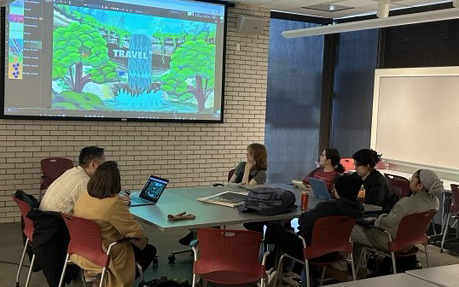
ACW is thrilled to join MCAD for a real life partnership. ACW has committed to be the client for the fall semester MCAD Animation Class. The client acts as the project’s creative director and provides materials like a synopsis, script, pre-recorded audio, reference images, video soundtrack, or voiceover talent at the beginning of the semester/project. Each project proposal is unique, and faculty can offer feedback on what materials would best support the project and student success. ACW will receive 8 – 15 second videos on topics of our choice. Project managers are Barbara Bridges and Kelly Frankenberg and they will be attending the weekly class. ACW Intern, Zoe Grigsby will be creating original sound tracks for the videos. The students will be creating provocative conversation starting content and ACW hopes to use these videos to spark virtual conversations on our social justice topics.
Screening Dec 10 1:30-3:00.
We will be creating- Art To Change The World ! Contact Barbara for info: drb@bridgescreate.com
About the MCAD Animation Collaboration Class
The Animation Collaboration course is an immersive experience for students and clients alike.
Students of Junior Standing and above can work in a collaborative environment with their peers
and at the direction of a client outside of MCAD. The project’s outcome varies depending on the
student’s skill level and focus in animation, 2D, 3D, Stop-motion, etc. Assignments simulate a
small studio production model and prepare students for the collaborative work environment of
professional animation. Read more about MCAD https://www.mcad.edu
Learn more about the videos that were created below! And watch all the videos HERE. (link coming soon)
Deadname Funeral

Have you ever thought about what your name means to you? What if you felt like it
didn’t fit, so you wanted to create a new image for yourself? What happens to your old name?
For the trans community, the relationship with our name identities can be complex, but in this
case, that old name is now dead, hence, deadname.
Our project initially juggled a couple different concepts, as we had many important topics we felt were noteworthy to talk about, but it eventually evolved into a literal deadname funeral.
The short film features a trans woman saying goodbye to the name she once had, symbolizing her leaving behind her past identity and actively moving on. Our first pass was a little lackluster and focused more so on comedy than on the goal Art to Change the World had in mind for the project. After additional feedback, the tone shifted to a bittersweet feeling and more grounded in a real trans experience (shoutout the notes we got from a trans ACW member!)
From the jump, we wanted to make sure that the trans colors were obvious throughout the setting of the film, from the flag over the casket, the casket itself, to the flowers spotted throughout the funeral home, and the wall decor. We furthered this idea with the main character, too, making the marker she uses to fix her drivers license pink, and her dress blue, which contrasts outdated ideas of what gender blue is meant to represent. Even the flower in her hair is symbolic. It is the red spider lily, representative of death and rebirth, which fit our trans theme perfectly.
Overall, our group is content with what we made! We made the project work in the time
parameters given, with a message that is important to us and we hope it spreads insightful
information about the trans experience to those curious. This project is ending on a high note.
Thank you for watching our short film!
HOW DOES YOUR NAME DEFINE YOU?
Credits:
Fyra Waqar: Voice of Amy, Character Designer, Animator, Assistant Compositor, Sound Editor
Julia Brock: Director, Animator, Background Artist, Main Compositor
Gabbie Martinson: Story Writer, Character Designer, Animator, Assistant Compositor
Valerie Guerrero: Storyboard Artist, Animator, Assistant Compositor
Zoe Grigsby: Music Composer
Crushed by Capitalism

The key idea behind this project was to create an animation that not only highlights important human rights issues, but also brings people together in the end with a common goal of making the world a better place. We began by assessing each other’s skills and preferences. Our group consists of three predominantly 3D artists and one primarily 2D artist. With this mix, we decided to create a mixed media piece, utilizing our skills in both mediums and combining them to make a visually engaging final product.
There were several challenges we faced in the process that we had to overcome as a group. Our first challenge was figuring out how to morph objects into other objects. This was accomplished through a very complex geometry node system inside the program Blender. Another challenge that we had to overcome was figuring out how the two mediums might interact with each other. Despite having to balance using contrasting animation software, ToonBoom and Blender, we still had to figure out a way to animate in a way that was not only seamless but believable. To overcome this, we engaged in frequent file sharing between the mediums, using 2d animation as a reference to build 3d animation, and vice versa.
We also had to consider how we were going to use type in our animation. We initially planned on using the provided font, but soon realized that it wasn’t matching the visual style of everything else. We wanted something easy to read but also stylistically consistent with the rest of the piece. In the end, we created a claymation-style font with added animation to give it some character. Finally, we added our additional 3d background objects to populate the space and complete the composition. Then, using some compositing magic, we could make sure the objects interacted believably with each other by utilizing lighting, shadows, and color.
In conclusion, we are proud of the final result and how successfully we were able to merge our different artistic strengths into one cohesive and interesting piece. We are also pleased with how the projects allowed us to shed some light on some very heavy and meaningful topics in a way that resonated with our client.
HOW CAN WE SCULPT A BETTER FUTURE – TOGETHER?
Credits:
Maria Ontiveros: 2D Animator
Jordan Flitter: 3D Artist
Victor Nord: 3D artist
Lee Hart: 3D Artist
Zoe Grigsby: Music
Disappear The Queer
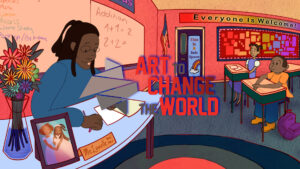
Our work is about identity erasure as it pertains to queerness within K-12 public schools
in America. As we increasingly move the bar on what is allowed, we restrict queer visibility for
future generations. Our question, “When is it okay to say gay?” is meant to ask a quantifiable
question at the heart of the issue. It inevitably invites further dialogue and questions like “How
does this impact a developing generation?” or “Who decides when and where is queer identity
appropriate?” As queer artists ourselves, we’re very aware of the lack of LGBT role models in
schools and just childhood in general. We want to create art that guides the up and coming
generations throughout their journey of self discovery, and censorship laws like these prevent us from doing so.
We chose each element of our work carefully to emphasize our messaging to the highest
degree. The background and character design utilize strong saturated colors to contrast heavily
against the black and white hues the film ends on. Lots of little details were included such as
posters changing colors and/or messaging, removal of certain room decorations, and the fading
of certain characters and objects. A number of background objects that disappear are real
books and posters that have been removed from classrooms within the past few years. We
wanted to really illustrate the damages that this censorship can have in a classroom setting by
visualizing the differences in a welcoming environment versus a rigid, intolerant one.
The process for developing this was hugely experimental for all of us. As the video
includes only one panning shot, this necessitated us to have a strong yet flexible understanding
for who was doing what work. The compiling of all animation and background elements together was certainly the most thoughtful challenge we encountered. Many components were separated into layered pieces to make it work, such as the characters’ arms, legs, as well as duplicates of background objects— but with enough trial and error, we were able to bring the project to the state we originally envisioned.
WHEN IS IT OKAY TO SAY GAY?
Credits:
Jon Passig
Reese Janacek
Skye Hope
Sylas Allen
Dirty Secrets
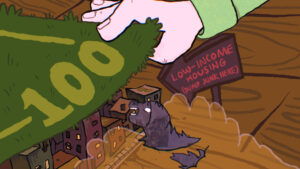
What are our politicians sweeping under the rug? Governing authorities have
developed a bad habit of pushing unwanted waste and byproducts into communities
that don’t have the financial resources to legally fight back.
Our project began with research into environmental justice issues around the United States. We put together moodboards and collages and started ideating on the story we wanted to tell and how we would be able to move people’s hearts. We arrived at a personified story of how environmental injustices take place: a giant mayor sweeping his monster of junk under a rug and into a city of miniature people who don’t have the means to fight back. We wanted to incorporate collage textures into the final work because we wanted to address garbage pollution, and by using scrapbook textures we were able to animate real trash into our fictional monster.
Our background designs featured color palette contrasts between the Mayor character’s suburban home and the polluted city. We chose more muted browns and yellows to highlight the pollution of the devastated neighborhood, and rich, saturated tones to emphasize the luxury of the Mayor’s clean home. The size contrast between the massive Mayor and the tiny people living under the rug also emphasized the power dynamic. The Mayor was designed with a confident gesture leading into his fluid hair swoop, to further emphasize his power and self-absorbance.
WHAT ARE OUR POLITICIANS SWEEPING UNDER THE RUG?
Credits:
Alex Bongaarts: Producer, main compositor, character animator
Faith Miller: Character & background designer, character animator
Ian Kapushinski: Character and effects animator, character designer
Samara Sturges: Storyboard artist, character animator, sound design
Zoe Grigsby: Score composer
Big Banned Books

Our piece is about taking back banned books, the power of collective resistance, and the
importance of libraries and accessible learning. We wanted to focus less on the censorship itself
and more on the communal fight against it, aiming for not just awareness but momentum and
hope.
We conveyed these ideas through formal elements like color and lighting, with the first
half having a cold and gloomy undertone and the ending shots after the books are returned being more sunny and warm. Between these shots, value and contrast are used as the books are taken to a dark, isolated realm, juxtaposing with the bright, populated world they are returned to. This furthers the idea that banning books distances us from reality and each other; taking them back unites and reconnects us. Compositionally, the scale of the big hand compared to the scale of the wave of hands adds to the theme as each individual hand is small but comes together to create something much bigger. The project also uses varieties of textures and material techniques found in and inspired by children’s books; using physical textures further grounds the narrative in our real, physical world.
We felt encouraged to try a lot of new things for this project, including: a very layered blend of stop motion and 2D digital animation, compositing fabric textures from images onto the characters’ clothes, learning pop-up book making techniques and creating real pop-up
establishing and closing shots, creating and animating a paper puppet, and taking on styles or
aspects of the animation process we might not have thoroughly explored before. We were all able to really shine and not only figure out how to be chameleons working with a uniform vision, but at the same time, bring something recognizably our own to the table.
WHAT BANNED BOOK IS ON YOUR SHELF?
Credits:
Macintosh Harroun: Storyboarder and Compositor
Ali Astrup: Character Designer, 2D and Stop Motion animator
Toshala Nauth: 2D animator and Background designer
Max Ylvisaker: 2D and Stop Motion animator
Medical Graffiti

Our project explores how people are instantly categorized based on their clothes, actions, or even the slang they use. These surface-level traits often give off false impressions about what a person is capable of achieving. Because of this, we wanted to create a short that highlights this concept in a highly exaggerated way, forcing the audience to confront their own biases.
Our creative process was not linear; the concept evolved significantly from our first pitch. Originally, the execution was rough. We faced specific challenges with camera movement and pacing that made it difficult to distinguish who was who in certain scenes. We realized we had to refine the visual language to make the characters distinct. We also spent a long time debating the core visual metaphor: how does graffiti translate to a “doctor” role? We had to experiment to see if those two opposing aesthetics could coexist without confusing the narrative. Design-wise, we focused on texture to bridge that gap. For the graffiti the doctor sprays, we avoided flat colors. Instead, we aimed for a texture that was both “rough” and “soft,” emulating the way real spray paint sits on a wall. This design choice helped ground the graffiti in the scene, making it feel like a tangible part of the environment rather than just a graphic overlay.
Ultimately, we are happy with how the piece came together. The process taught us that while a core idea might be strong, the technical elements like smooth camera work and texture are what actually sell the story to the audience.
HOW HAVE YOU BEEN MISJUDGED?
Credits:
Emrah Mehmedovic: Director – Character Designer
August Feesl: Animator – Character Designer
Max Giammona: Animator Final Shot – Storyboard Artist – Character Designer
Isabel Erazo: Animator – Storyboard Artist
Ryu Xiong: Editor
Dragphobia

Dragphobia is a story behind the fear of drag performers around children. It informs the audience of the history behind the art form of drag and how it has persisted across the world.
Working with the intersections of queerness, age, and performance art, we hope to explore the
various facets of these buried stories. We see that drag isn’t something new and has been both
celebrated and hated throughout time. It’s time to shed light on those with biased fear. Drag isn’tsomething new; rather broadly misunderstood.
Our story begins in modern-day in a library with a drag queen telling a story for children
eager to listen. We flip through the pages, drawing awareness on the vibrant history and culture
of drag. We couldn’t dream of showing all the variety of drag that’s out there, but settled on a
few distinct styles of 1920s drag kings, WW2 drag soldiers, 80s punk, and 90s glam rock.
From concept art to a full-fledged short film, our team has worked hard through the challenges.
In the beginning, we all had different ideas, but came to a collective to support and
shed light on the drag community. We each split the work up with what we enjoy doing and
wanted to learn more about. Using colorful and shapely geometric visuals, we were able to find a cohesive puppeting animation that we could all use and match our styles. While faster than
traditional hand-drawn animation, puppeting still has its limitations. We had to be sure of the
movement we planned on far in advance so we could create a rig to suit those needs. As a team, we tackled every challenge and supported each other through and through. Overall, we couldn’t be happier with our film!
DOES THIS MAKE YOU AFRAID? WHY?
Credits:
Aaron (Wren) Dawley: storyboard/animatic, lighting, character rigged animation, background animation
Avery Clark: backgrounds/props, character rigged animation, overlay hand-drawn animation
Ren Curry: character rigging, compositing, crowd animation, group leader
Eleanor (Juno) Fister: character art, character rigged/drawn animation, audio mixing
Unholy Inheritance

Our project is about wealth inequality, specifically a capital gains tax loophole named the
Angel of Death. Capital gains are the increase in the value of an asset over time that represent
income to the asset’s owner. However, the U.S. revenue code only taxes the gains on these assets when they are sold. The Angel of Death swoops in when assets are passed down to the next generation and the previous owner’s gains are never taxed. This massively benefits the richest Americans.
We decided to personify the Angel of Death as a dominating and imposing statue. The
angel mixes features of a grim reaper-esque figure with those of a Bull, a nod to the Charging
Bull statue that is an icon of the New York stock exchange. The green and red arrows in each of
its hands represent the stock market and the class divide between Wall Street and the average
American.
The statue is much larger than the crowd below, showing that this tax loophole is
formidable and looms over the American working class. We decided to include imagery of the
crowds below coming together to bring the angel of death down, showing that when people work together, they can overcome regressive legislation. The old man and the young woman have differences in race and generation, but ultimately work together to fight the same issue.
The message we hope to get across to the audience is one of a shared struggle against the same issue, and of working together for tax reform. This is where the final question comes into play: “Who can we trust to manage the gap?” Our group wants to spark conversation on who we’re trusting to fight these legislative battles, and how we can work together to make a change.
WHO CAN WE TRUST TO MANAGE THE GAP?
Credits:
Nicole Reiling: 3D Specialist, Compositing | nreiling.works@gmail.com
Emmanuel Lykes: Storyboard Artist, Animation, Sound Designer | EmmanuelLykes.com
Lukas Bender: Screenwriting, Animation, Character Design | polarpotions.carrd.co
Celeste Wilburn: Character Design, Background Design, Animation | Insta: @Scribbledbypeach
Music: Road to Mordor by Ezra Lipp
Skeleton Model: Human Skeleton Download FREE from RogerSIQ3dstore on Fab