Extended Pronoun Policy
Introduction
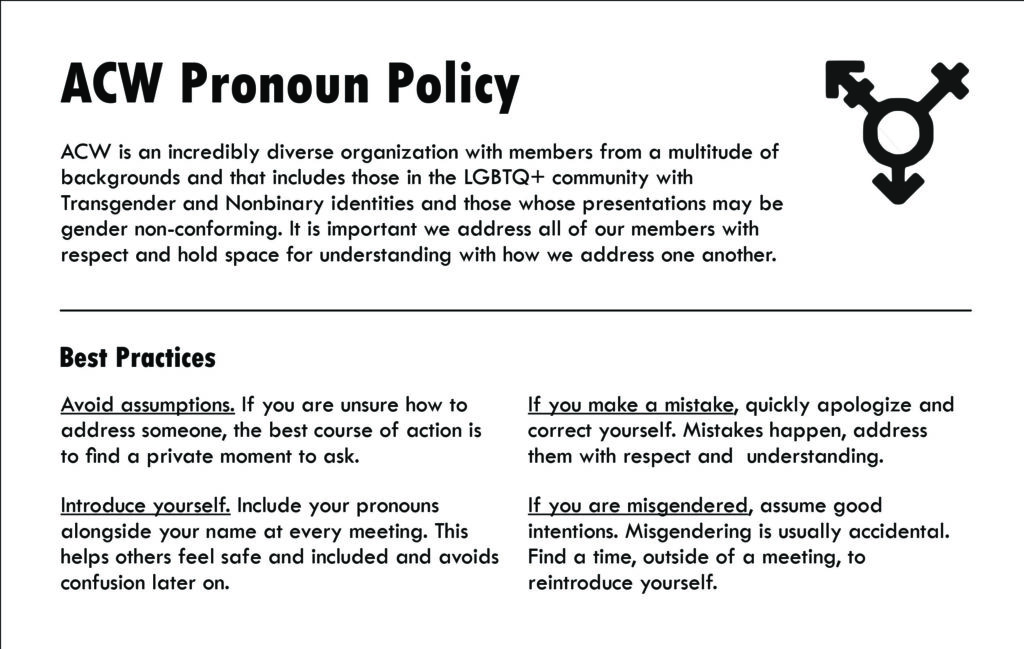
- ACW is an incredibly diverse organization with members from a multitude of backgrounds and that includes those in the LGBTQ+ community with Transgender and Nonbinary identities and those whose presentations may be gender non-conforming.
- Transgender: An adjective describing someone who identifies as a gender other than the one associated with the sex they were assigned at birth.
- Nonbinary: An adjective describing someone who does not identify with one of the binary genders, man or woman. There are many kinds of nonbinary identities and are not to be confused with a singular ‘third’ gender.
- Gender Non-Conforming: An adjective describing anyone whose gender identity or gender expression does not align with traditional norms of male or female. This term is not exclusive to transgender individuals.
- It is important we address all of our members with respect and hold space for understanding with how we address one another. One way we show respect for one another is by learning and using each other’s names. Names hold respect and recognition of identity and personhood. It is important that we remember pronouns that hold the same weight, so just as we make sure to get someone’s name right, we must also do the same with one’s pronouns.
Avoiding Assumptions
- If you are unsure how to address someone, the best course of action is to find a private moment to ask. Ex. “What pronouns do you use? I use He/Him.”
- Try not to make assumptions about others, always ask if you are unsure.
- This is just the same as if you have forgotten someone’s name. You address them respectfully in private and make sure you know how to address them.
- If you are unable to ask the person in that moment the best course of action is to use neutral pronouns or avoid pronouns and just use the person’s name until you know for sure how someone wants to be addressed. Ex. “They had some really great ideas!” Or “[NAME] will be back soon. [NAME] went to go get food.”
- ‘They’ as a singular pronoun has existed since the 14th century and we often use it when the gender of the subject is unknown. Ex. “Someone left their keys here.” or “They are hiring a new person I hope they are nice”
- If you are struggling with the singular they pronoun remember it is conjugated the same as the plural form. Ex.” They are cool”, “Look at them go” or “That is their car”.
Introducing Yourself
- Generally during ACW meetings and events it is customary to introduce yourself with name, pronouns, and your artistic medium.
- Including pronouns when you meet someone and sharing your own is a great way to make sure everyone is addressed respectfully and there is no confusion. It is also a great way to make others feel safe and included.
- “Hi, I am [] and I use [] pronouns.”
Misgendering
- Misgendering occurs when someone addresses another with inappropriate gendered language. This can happen to anybody but more often happens to those who are transgender or gender non-conforming.
- If you have been misgendered
- Find a quiet moment to address the person and assume good intentions. People do not often misgender others on purpose and may simply misspeak or forget. Ex. “I heard you say [] and I just wanted to let you know I go by [].”
- Avoid interrupting a meeting to address the issue with a single person. If more than one person at the table is misgendering you, quickly reintroduce yourself.
- If you have misgendered someone else
- If you misspeak while speaking and immediately realize your mistake it is okay to quickly correct yourself and move on. Ex. “He, sorry, she.” There is no need to draw too much attention to this mistake. Often an overdrawn apology can make someone more uncomfortable than correcting yourself and quickly moving on.
- It is also okay to apologize in private if you realize you have been addressing someone incorrectly. Again a quick polite apology is usually best. Ex. “I realize I have been saying [] when I should be saying [], I apologize.”
- If someone approaches you about misgendering them. Try to acknowledge your mistake and thank them for bringing it to your attention. It is easy to get defensive when someone corrects you but realize they are not criticizing you, mistakes happen, they are simply making sure they are respected and that can sometimes take courage to do. (Imagine someone has forgotten your name for example, correcting them might be difficult).
- Always try your best to respect and remember others’ pronouns just as you would their name. Mistakes happen, just make sure to address your mistakes with respect and understanding.